
Free Experience — Rubelis Beyond
What Is Learnt Underwater?
Approximately 25 minutes of reading
Diving is not entering the water. It is surrendering to it. And learning to surrender takes years.
— From a diving instructor's notes, 1987
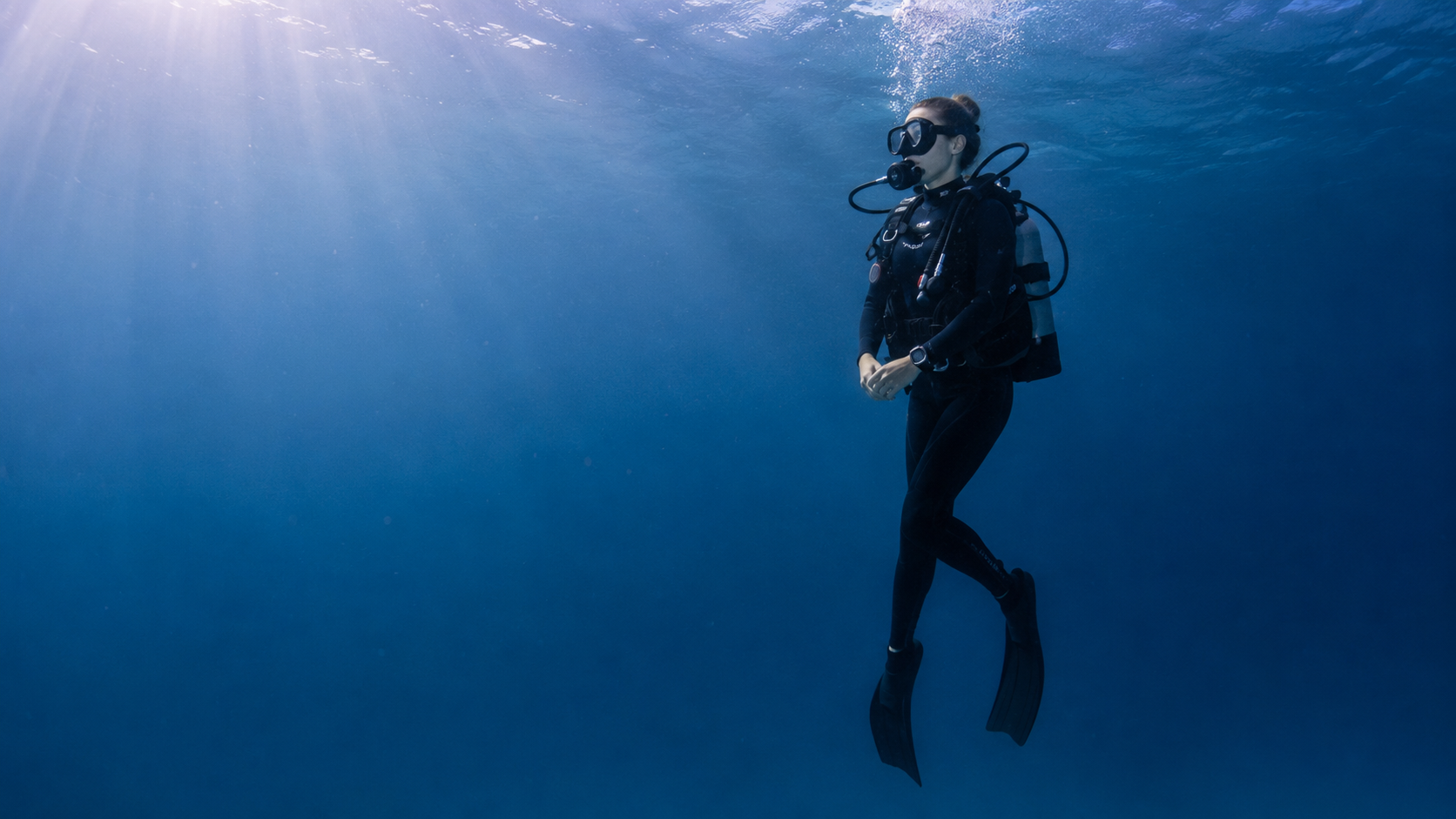
The first time you descend underwater, there is only one thing on your mind: breath. Slowing it, regulating it, keeping it steady. All your attention converges on this single point. Everything around you — colour, light, sound, movement — becomes background noise. You are not simply breathing; you are learning how to breathe.
This is the first thing diving teaches you: that something you considered indispensable for survival can, temporarily, be let go.
But this is only the beginning.
Body, Mind and the Language of Water
Most divers learn diving as a skill. They fit the equipment, memorise the procedures, learn the safety rules. These are necessary. But they are the surface, the shell of diving. The real learning begins beneath this shell.
Underwater, the body behaves differently. Weight decreases, but resistance increases. Movement slows, yet each movement becomes more meaningful. A single hand gesture can propel you forward or waste energy needlessly. Water penalises every excess movement; it converts every unnecessary tension into air consumption.
Scientific Note
During a dive, the human body exhibits a physiological response known as the 'diving reflex'. When the face contacts cold water, heart rate slows, peripheral blood vessels constrict, and blood is directed towards vital organs such as the brain and heart. This reflex is an evolutionarily conserved mechanism in mammals. Experienced divers learn to consciously trigger and manage this reflex.
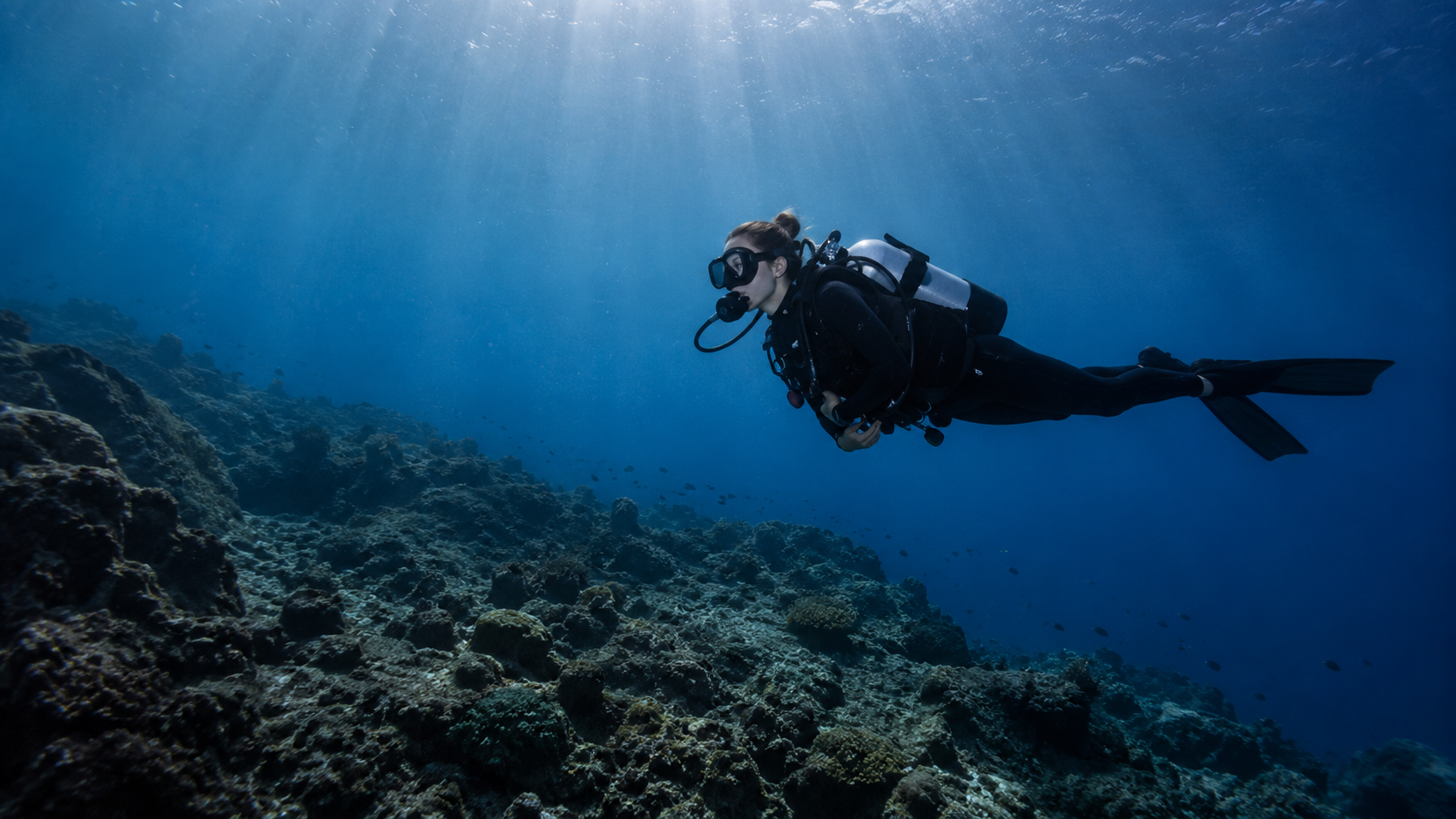
When an experienced diver enters the water, to an observer it appears as though almost nothing is happening. The fins move gently, the body glides. But behind this visible simplicity lies a bodily awareness built over years. A body that knows which muscle to relax and when, when the breath finds its own rhythm, how to use the resistance of water.
The Fine Line Between Panic, Control and Trust
There is something not taught in diving training but which every diver must sooner or later learn: meeting panic.
Panic is fatal underwater. Everyone knows this. But very few truly understand how panic begins, at what moment it takes hold, how it is recognised. Because panic does not begin with great fear — it begins with a small discomfort. A slight leak in the mask. An unexpected current. An unfamiliar sound from the equipment. This small discomfort is the first sign that the mind is beginning to lose control.
Experienced divers recognise this moment. And because they recognise it, they know what to do: nothing. They stop, regulate their breathing, observe their surroundings. Rather than allowing the body's reflex response, they create a mental pause.
The most important thing I learnt underwater was learning to be still. Both with my body and with my mind.
— From a technical diver's journal
This skill — being able to remain still in a moment of panic — is not unique to diving. But diving offers an unparalleled environment in which to learn it. Because water gives you immediate feedback. When you respond incorrectly, water tells you at once.
Depth and Perception: Time Flows Differently Underwater
Time works differently underwater. This is not merely a feeling; it is a perceptual shift that many divers experience and report. Many divers underestimate the time they spend underwater by a significant margin. A forty-minute dive may have felt like fifteen.
Scientific Note
The shift in time perception is associated with the intense focus and sensory changes experienced during a dive. The brain encodes time markers differently in situations requiring concentrated attention. Furthermore, under the influence of nitrogen narcosis — particularly below 30 metres — cognitive functions alter and time perception can shift even further.
But this is not merely a distortion. Experienced divers recognise this temporal shift and learn to work with it. Underwater, the 'present moment' is lived more intensely. The past and future do not occupy as much space as they do at the surface. This is a state of consciousness that meditation practice spends years trying to reach — and diving produces it almost automatically.
Equipment, Dependence and the Paradox of Freedom
Diving equipment keeps you alive underwater. But it also ties you to the underwater world. This paradox contains one of diving's deepest lessons.
For a new diver, equipment is a guarantee. As long as the regulator works, the cylinder is full, the mask does not leak, everything is fine. But as experience grows, this guarantee is revealed to be an illusion. Equipment can fail. The cylinder can empty sooner than expected. And at that moment, dependence on equipment becomes a weakness.
This is why advanced diving training includes working without equipment or with minimal equipment. Freediving is the purest expression of this philosophy: with only your own breath, your own body, in the water. Without equipment, the body discovers its own limits. And those limits are, more often than not, far wider than imagined.
When you remove the equipment, only you remain. And that is both the most frightening and the most liberating moment.
The Buddy System: Trust, Responsibility and Human Connection
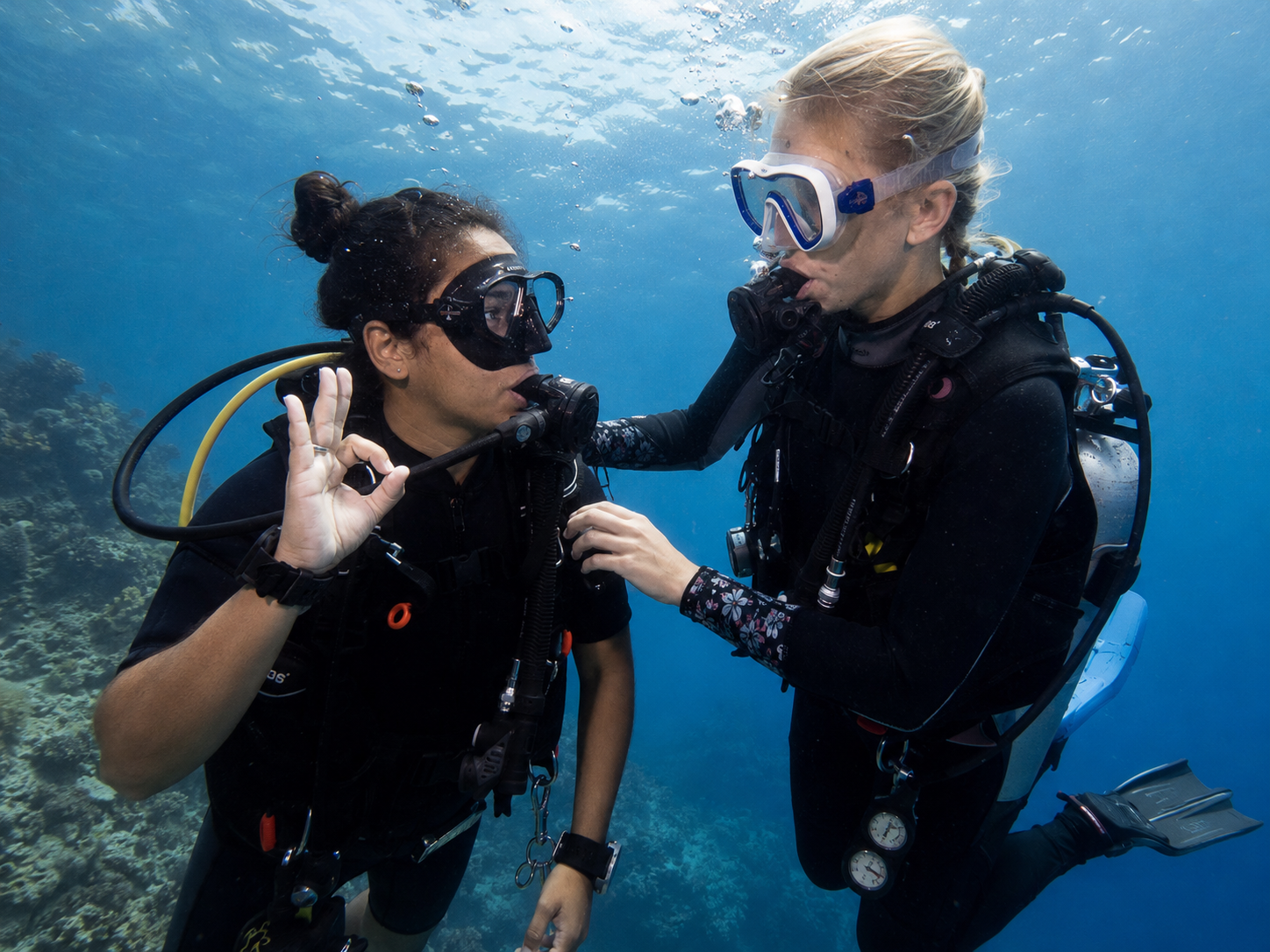
Diving appears to be an individual experience. But one of the fundamental safety rules is never to dive alone. The buddy system — the dive partner system — is not merely a safety protocol. It is also the expression of a deep relationship of trust.
Your dive partner watches you. Checks your equipment. Is the first to respond when something goes wrong. But more importantly, they are the person with whom you share your experience before and after the dive. What you saw, what you felt, what surprised you.
Experienced divers come to understand the value of a good buddy over the years. Technical skill matters, but trust matters more. Underwater, knowing that someone trusts you — and knowing that you trust them — fundamentally changes the quality of the dive.
The Underwater Environment: What You See and What You Do Not
What you see underwater is only a small part of what is actually there. This is both an optical reality and a philosophical observation.
Light refracts differently in water. Colours disappear with depth. Red becomes invisible within a few metres. Orange, yellow, and green fade in turn. At sufficient depth, the world turns to shades of blue and grey. When a diver notices that the red equipment in their own hand appears grey, they understand how conditional perception truly is.
Scientific Note
Water absorbs light selectively. Long wavelengths (red, orange) are absorbed far more rapidly than short wavelengths (blue, violet). This is why red almost entirely disappears below 10 metres. Divers therefore use artificial light sources in underwater photography — to restore the true colours.
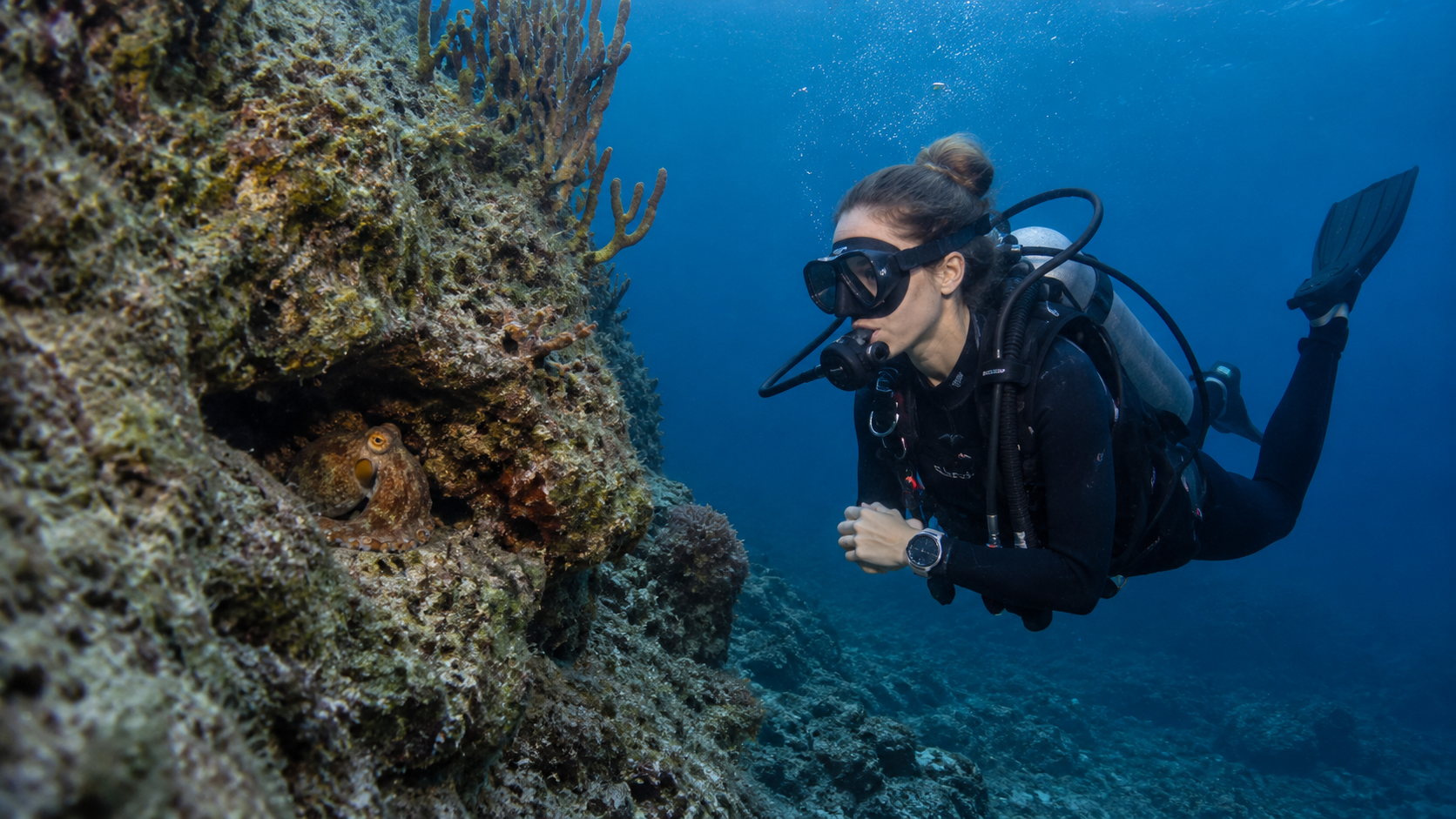
But it is not only colours that are invisible. The great majority of underwater life goes unnoticed without a careful observer. A flatfish buried in the sand. An octopus beneath a rock. A small crab inside the coral. The underwater world does not reveal itself easily. To see it, one must slow down, wait, and watch.
Seeing, more often than not, simply requires looking a little longer.
This too is a skill that diving teaches: learning to see. Not merely to look, but to truly see.
Planning, Flexibility and the Unpredictability of Water
Every dive begins with a plan. Maximum depth, duration, route, emergency procedures. This plan is the skeleton of the dive. But water loves plans — and breaks them.
The current may run in an unexpected direction. Visibility may be lower than anticipated. An equipment issue may require changing the plan. And experienced divers know how to respond to these changes: not by preserving the plan, but by preserving the purpose of the plan.
This distinction matters. The plan is a tool. The purpose is to make a safe and meaningful dive. When conditions change, the tool can change; but the purpose does not. Inexperienced divers cling to the plan. Experienced ones know when to let it go.
Beyond the Dive: Carrying What Is Learnt Underwater to the Surface
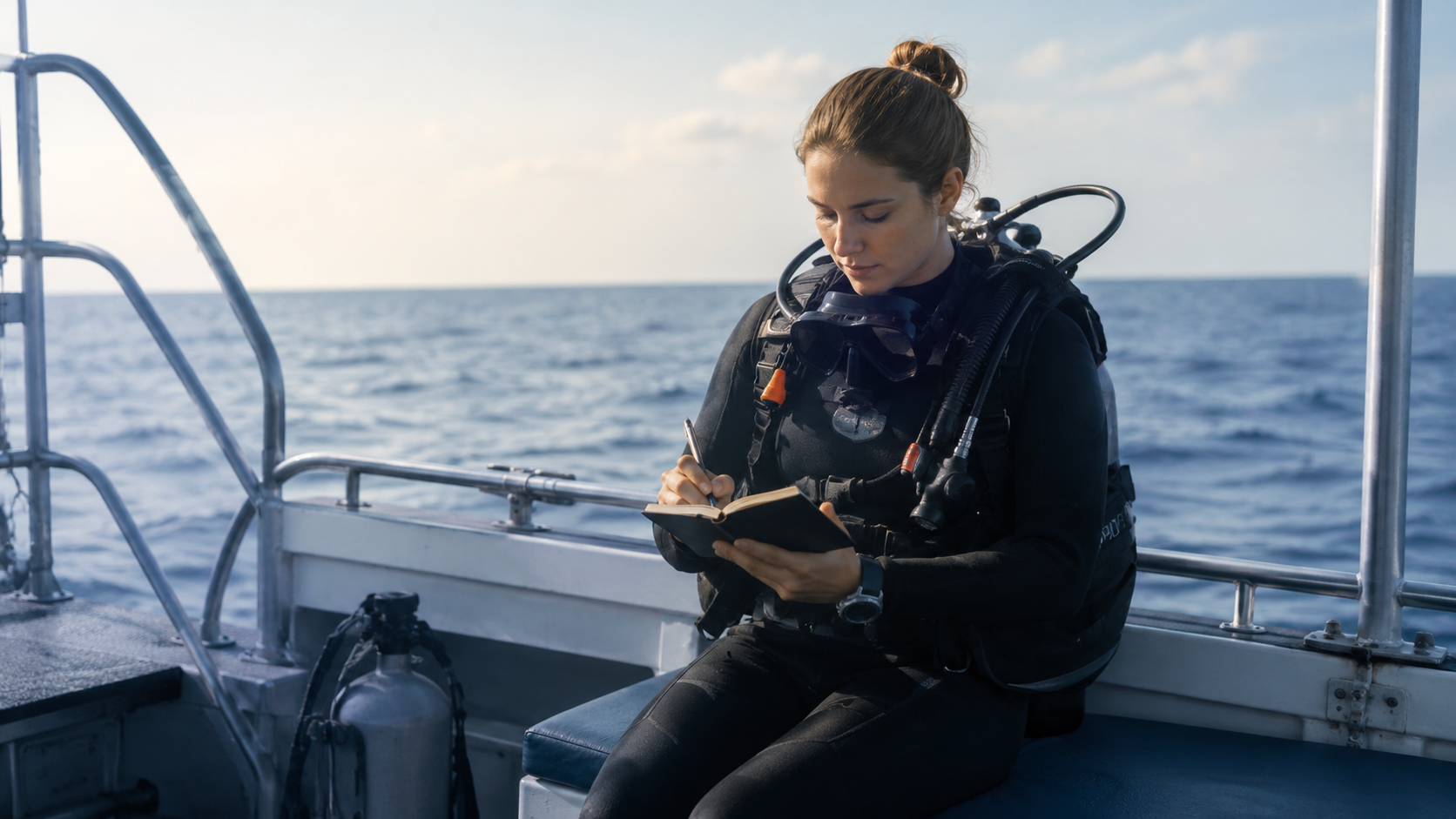
Diving is not an experience that ends underwater. The real learning begins after surfacing.
After every dive, experienced divers conduct a review. What they did right, what they did wrong, what they could have done differently. This review shapes the next dive. And over time, this cycle — dive, review, improve — becomes a practice of mastery.
But these learnings are not unique to diving. Managing panic, making decisions in uncertainty, building trust, learning to see, being able to let go of a plan — all of these apply above the surface too. Diving offers an extraordinary laboratory for learning these skills. Because water meets you with immediate and honest feedback.
I use what I learnt underwater at the surface too. But I only realised this years later.
— From a diver's journal
Rubelis Beyond seeks to make these learnings systematic. It addresses not only the technical dimension of diving, but also the mental, emotional and philosophical dimensions. Because diving is not simply a sport. It is a way of thinking.
Key Takeaways from This Experience
- 01
The most fundamental thing learnt underwater is that what you considered indispensable can, temporarily, be let go. Breath is the first lesson in this.
- 02
Panic does not begin with great fear — it begins with small discomfort. Recognising it comes before managing it.
- 03
The dive does not end underwater. Real learning begins after surfacing, in the cycle of review.
Personal Note
Note something that stayed with you from this experience. A question, an observation, a feeling.
Saved
About this experience
What you have just read is not a summary of any of the 12 chapters of Rubelis Beyond. This is only an introduction — an original text written to convey the perspective, language and depth of the programme. The actual content goes far beyond this.